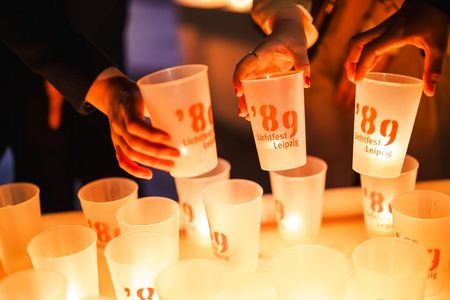
As one of the key issues of our time, we are also committed to optimising the implementation of the Festival of Lights. At the Festival of Lights, we view sustainability as an ongoing process of improvement. We are currently focusing in particular on materials, such as candles and cups, consistent waste separation, event technology, monitoring energy consumption, as well as mobility and communication.
Sustainability
at the Leipzig Festival of Lights
Candles and waste reduction
-
At the 2024 Festival of Lights, 20,000 reusable cups replaced the PET cups previously used for the candles for the first time. The cups are collected after the event, stored and reused for future Festivals of Lights. The reusable cups are made of polypropylene and designed for multiple use; according to the manufacturer, they can be recycled. The reusable cups are supplied by the Chemnitz-based company EmotionVibe – meaning that we are working with a regional provider in this area.
-
Conventional tealights made with paraffin wax and aluminium casings are also not used at the Festival of Lights. Instead, tealights made from rapeseed wax and with casings made from recycled plastic are used. Tealights that have already been purchased will first be used up in order not to dispose of functional materials and to avoid unnecessary new purchases.
-
Reusable materials will also be available on 9 October for the candle stands and for providing refreshments to the volunteers on site (candle stands with a notice about digitally available information, vacuum flasks and reusable drinking cups).
-
Together with Stadtreinigung Leipzig, collection systems have been set up for optimal waste separation. All volunteers on site are briefed so that they can also provide visitors with correct information.
Technology and energy
The tender documents for participating artists request specific sustainability information, including travel planning, material use, reusability of installations and technical energy efficiency. When working in partnership, we give priority to local partners. Where organisationally possible, coordination takes place digitally in order to avoid additional business travel. Unavoidable business travel is recorded and calculated using a greenhouse gas calculator (primarily E-Tool). For the resulting emissions, LTM supports regional and local (climate protection) projects to a corresponding extent.
We consciously select and work with local service providers for technical services, infrastructure and procurement – helping to reduce necessary transport routes. For new constructions, we give priority to materials containing recycled content and structures that can be reused after the Festival of Lights. For subsequent use, we seek partnerships with local associations and initiatives. Wherever possible, we use LED technology and reusable technical equipment for event technology. Energy consumption on the day of the event is recorded and evaluated for planning future Festivals of Lights.
Since 2021, we have calculated the carbon footprint of the Festival of Lights. This takes into account, among other things, electricity consumption, mobility (artists and transport of materials/technical equipment), printed materials and catering for cooperation partners and volunteers. We use the results to identify potential savings for future events. Since 2022, LTM has also supported regional (climate protection) projects, such as NABU Leipzig, through donations. This support does not replace the reduction of emissions at the event itself; it complements our measures to reduce energy consumption, material use and avoidable travel.
Mobility, communication and accessibility
For journeys associated with the Festival of Lights, we favour means of transport with lower direct emissions: walking, cycling, cargo bikes, local public transport and rail. Air travel should be avoided wherever possible. If it is necessary in individual cases, the resulting emissions will be recorded; local projects will also be supported.
On 9 October, the Festival of Lights team will be travelling around the city centre mainly on foot, by bicycle or by cargo bike. We recommend that visitors use local public transport, bicycles or other shared mobility options to get here. Information on stops and bicycle parking facilities will be provided in good time before the Festival of Lights.
Information about the Festival of Lights is published primarily digitally. Printed materials are used only where they are necessary for visitor information. Poster designs are also made available digitally. Where possible, designs on items such as roll-up banners are kept general (without a year), so that they can be reused in future years. Certified paper is used primarily for printed materials.
When selecting participating artists, we seek to ensure the most balanced representation of genders possible. We use gender-inclusive language in our communications.
To ensure that the Festival of Lights and its individual projects are as accessible as possible, we provide, among other things, sign language interpreters, audio guides and wheelchair-accessible access to the installations. Further detailed information on accessibility at the Leipzig Festival of Lights and its projects will be provided shortly.