© LTM/Andreas Schmidt

For an open country with free people!

Light Space 6

Wilhelm-Leuschner-Platz, later Schillerpark

from 7 October 2019

Freedom shimmers
Short texts from Czechoslovakia, Poland, the GDR and other states behind the ‘Iron Curtain’.

Until the autumn of 1989, many people in Europe lived behind the ‘Iron Curtain’, in a part of the world considered socialist. Despite the utopian promise of those in power, this system of government was not ‘heaven on earth’, but for many of its citizens quite the opposite.

But what troubled people? What did they lack, given that (most of them) had secure jobs and material security? What moved them to take to the streets under slogans such as ‘For an open country with free people!’, to express their wishes and longings, and thus to stand up to those in power?

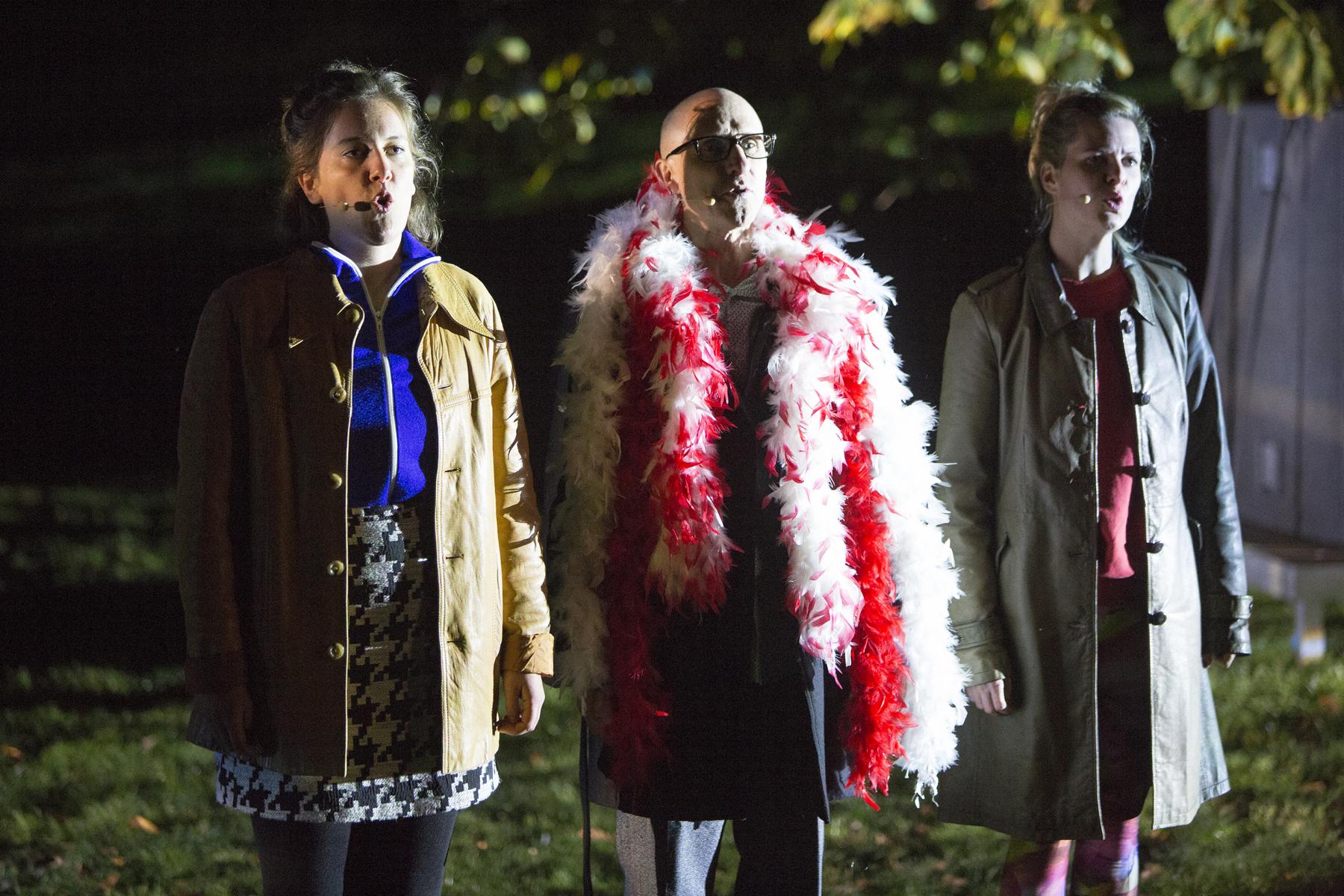
Here, the power of light is set against the power of words. A collage of texts – some distributed via stickers – filled this space of light: the spoken-word artists Rainer Holl and Josephine von Blueten Staub entered into dialogue and contention with 30 years of history and our present day. A musical contribution by singer-songwriter Stephan Krawczyk rounded off the opening of the space of light.
© Punctum/Stefan Hoyer

Organisers and partners

Lichtfest Leipzig 2019: Lichtraum 6 "Für ein offenes Land mit freien Menschen!" im Schillerpark (Lenné-Anlage)
© Punctum/Stefan Hoyer

Project partners: Polish Institute Berlin – Leipzig Branch (Bernd Karwen); Leipzig City History Museum (Johanna Sänger); Leipzig Citizens’ Movement Archive (Uwe Schwabe, Michael Wildt)

Wild encounters in the park
During the day, city parks are public places for recreation. As soon as darkness falls, they can transform. The park becomes a place of secrecy, offering protection from unwelcome looks and encounters with law enforcement. Laws set the framework for our lives, but they do not reflect social reality.

In Germany, the vast majority of people support full equality for homosexual people, yet women or men kissing one another in public are seen by many as an unpleasant disturbance. In the GDR, homosexuality between adults had no longer been punishable by law since 1968, but it was still not tolerated.

What happened in the Schillerpark on those nights? What does a park, then and now, have to do with the search for personal freedom and social equality? The performance with music and text explored this discrepancy.

Direction/concept: Christian Hanisch

Dramaturgy/research: Christoph Awe

Acting/live music: Karoline Günst, Alexander Fabisch, Victoria Schätzle

Live music: Gabriel Jagieniak