© Punctum/Stefan Hoyer

On the way to the 
Festival of Lights 2020

Part 4

Visiting the shared accommodation for refugees in Connewitz

28 September 2020

(Kopie 1)

Historical images from the autumn of ’89 opened the evening, giving the audience an initial impression of what had happened in Leipzig during the Peaceful Revolution. What it was like back then – civil rights activist Gisela Kallenbach was, of course, particularly well placed to describe this in conversation with presenter Claudius Nießen. “What kind of day was the 9ᵗʰ of October 1989 for you?”, Nießen asked at the beginning. 

"The 9ᵗʰ of October 1989 did not just change Leipzig. It was, in fact, the beginning of the Peaceful Revolution across the whole country. Four prayers for peace took place at the same time, and people no longer allowed themselves to be intimidated. They took to the streets with great courage. Not a single shot was fired that day; it was an evening of relief, but I also asked myself: What happens next?”, said Kallenbach.

Nießen then turned the focus to the present: “When you look at the here and now, where can people get involved, where should they get involved today?” Gisela Kallenbach’s answer is a clear appeal: “Fundamentally, I am glad that for 30 years I have been able to live in a free, democratic state governed by the rule of law. But if we look more closely: our world has become neither more peaceful nor truly fairer. Nor have we yet managed to preserve the natural foundations of our lives. That is why I believe that even today there are every reason to work for change.”

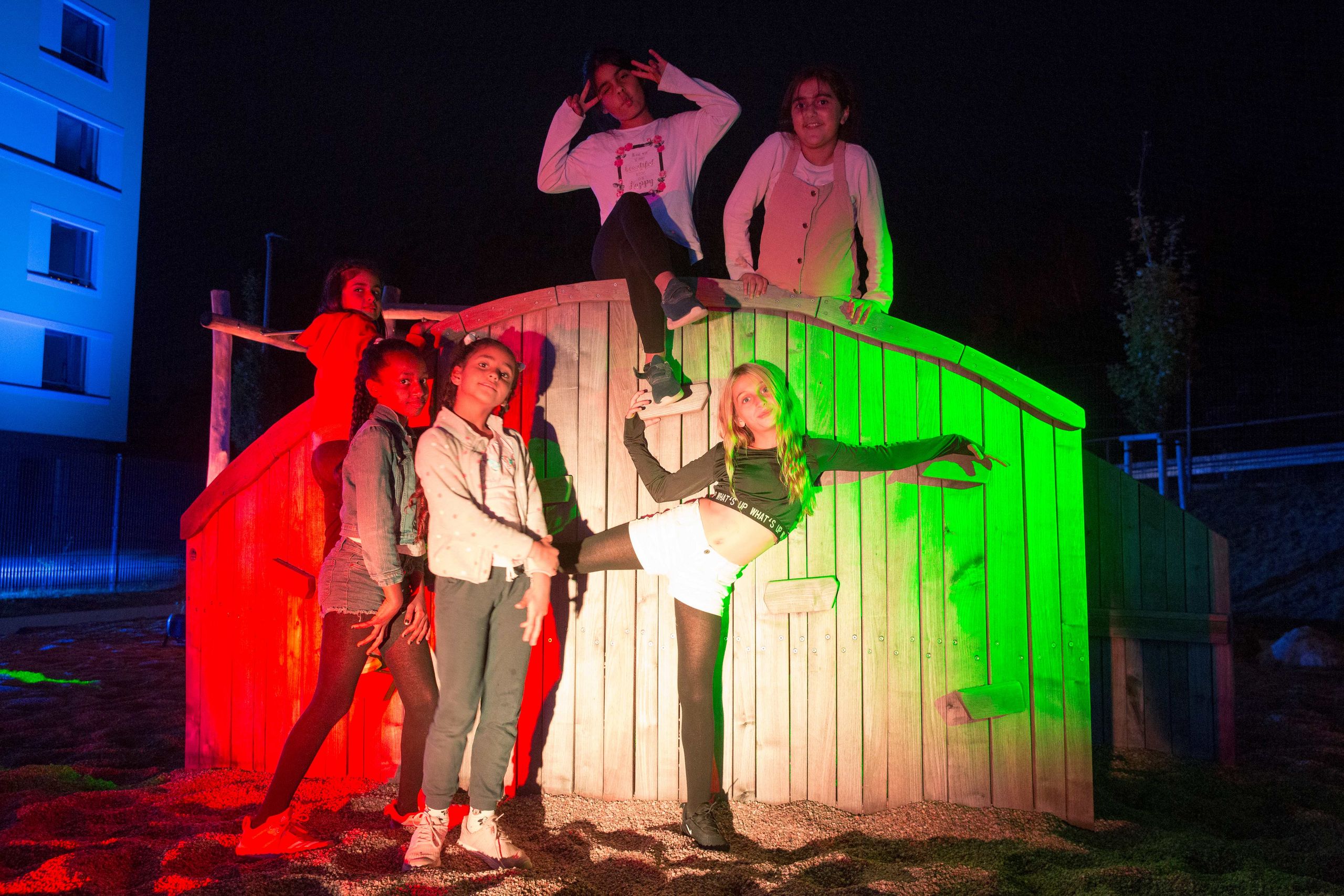
Choreographer Roman Windisch had developed a choreography entitled “Freedom” especially for this evening with six female dancers from his dance company human moves. In advance, they engaged intensively both with the topic and with the venue. Several meetings with the residents and staff of the communal accommodation ultimately provided the content basis for the evening performance on the playground in front of the accommodation. Gaining people’s trust was initially the main focus of the encounters; incorporating the refugees’ experiences and accounts into the choreography was the second step. The result was a series of impressive images.
© Punctum/Alexander Schmidt

Contributors

(Kopie 1)

Auf dem Weg zum Lichtfest 2020: zu Besuch in der Geflüchtetenunterkunft am 28. September 2020
© Punctum/Stefan Hoyer

Dance Company human moves: At human moves, the dancer thinks along. He is not merely an executing tool, but is integrated with his skills and personality. In this way, we ensure that an honest, inspiring and reflective reality is created. Elements from modern dance and dance theatre are used as means to create starting points and tell stories. Improvisation is also essential for every development process. Involving music and other artistic disciplines is also a major concern for human moves. The audience plays at least as important a role in the success of a piece - in the end, they must feel what is being said. Music: Ólafur Arnalds - The journey ; Markus Lindner - clouds  -  arranged by Alex Blue from Sunny Side Up Studio Leipzig. 

Gisela Kallenbach, born in 1944, is an East German civil rights activist and politician with Alliance 90/The Greens. In 1989, she was one of the founding members of the “Ökolöwe” association, a Leipzig environmental and church group represented at the Round Table. Previously, she had been an active member of the Environmental Protection Working Group at the Leipzig Youth Parish Office and, between 1987 and 1989, was involved in the Conciliar Process of the churches of the GDR. As a young woman, Kallenbach refused to take part in the Jugendweihe, which led the MfS to deny her the path to the Abitur. Instead, she trained as a laboratory assistant and completed a distance-learning course. She continued in this occupation until reunification. From 1990 to 2000, she was an adviser in the Department of Environmental Protection of the City of Leipzig and, until 1999, an assessor on the state executive committee in Saxony. Her international activities took her to the UN Mission in Kosovo. She subsequently represented the Greens in the European Parliament between 2004 and 2009. Today, the recipient of the Federal Cross of Merit sits on the Board of Trustees of “Bürger für Leipzig” and is a member of numerous non-profit associations. Source: https://www.zeitzeugenbuero.de/index.php?id=detail&zzp=68

In the autumn of ’89: “After the massive police operation on 7 October 1989, the 40th anniversary of the GDR, in several cities of the GDR, there was a threat that state violence would escalate on Monday, the 9ᵗʰ of October, if people again came together for the Monday Demonstrations in Leipzig. Public statements were not short of threats in this direction. People from various opposition groups then wrote a leaflet calling for non-violence, which was distributed in Leipzig city centre on the afternoon of the 9ᵗʰ of October. Gisela Kallenbach was detained by the police in the process. She recounts how, even in this situation, the police capitulated in the face of the solidarity of passers-by.” Source: https://www.archiv-buergerbewegung.de/themen-sammlung/zeitzeugen/44-kallenbach-gisela

© Punctum/Alexander Schmidt